Author Interview – Sarah McDevitt
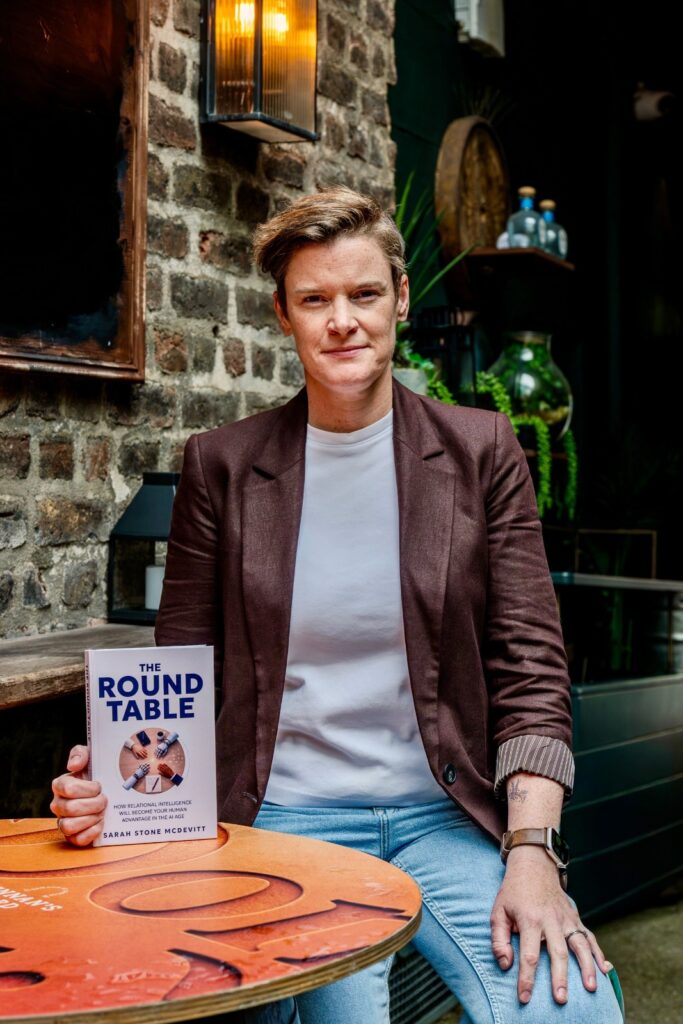
| The Round Table - New ReleaseAt The Book Shelf, we love talking to authors about their books, and today we’re delighted to talk to Sarah McDevitt, author of The Round Table: How Relational Intelligence Will Become Your Human Advantage in the AI Age.

The Process
Congratulations on the release of The Round Table. How long did it take you to write and/or publish your book?
The ideas in the book have been forming for most of my life, but the actual writing process took around a year. Like many first-time authors, I quickly discovered that writing the book was only part of the challenge. Editing, refining, publishing, and preparing for launch often took as much time as the writing itself. I had no idea what a developmental editor did but now I could not be clearer! Absolutely key to the book and its success.
What was your biggest challenge in the process of writing or publishing?
Without question, it was overcoming my own doubts. I’m dyslexic and for most of my life I never imagined I would write a book. I had plenty of stories and ideas, but translating them into a manuscript felt intimidating. Ironically, AI became part of the solution. It helped me bridge the gap between the ideas in my head and the words on the page.
What was your happiest moment in the process?
I would say, hearing from the experts in The Book Shelf, this was a story worth writing, very validating for me! And then holding the finished book for the first time. There is something extraordinary about seeing years of thinking, writing, and rewriting transformed into a physical object that can now travel into other people’s lives.
Do you have a day job, and how did you balance it with writing?
Yes. I work in the technology sector and balancing writing with a demanding career and four children was definitely a challenge! Most of the book was written early in the morning, late at night, or in small pockets of time wherever I could find them. My wife plays a lot of tennis so that was helpful!
What skill do you feel is the most important in becoming an author?
Persistence. Writing is less about inspiration than people think. Most days it’s simply showing up and continuing even when you feel stuck or uncertain. When people ask me ‘how’ my answer is “start’
If you could do anything differently in the process, what would it be?
I would have started sharing the ideas earlier. I spent too much time worrying whether they were ready. Feedback from readers often improves ideas far faster than keeping them to yourself. That’s what I found.
If you had one piece of advice for aspiring authors, what would it be?
Write the book only you can write. The world doesn’t need another copy of someone else’s story or viewpoint. Your lived experience is your advantage. Especially now with AI in the mix.
The Book
What is your book about?
The book explores a simple but increasingly important question: as AI becomes more capable, what remains uniquely human? I argue that trust, communication, empathy, judgment, relationship-building, and what I call Relational Intelligence may become some of our most valuable skills in the future.
That’s so insightful. What made you want to write it?
As a mother, business leader, and someone working in technology, I found myself asking what kind of world my children would inherit. We hear a lot about what AI can do, but I became fascinated by what humans still do better. The book grew from that question.
Who did you write it for?
I wrote it for anyone wondering where they fit in an AI-powered future. Leaders. Knowledge Workers, Founders, even Parents. Students. Professionals. People who are excited by AI and people who are worried about it.
What were your goals for the book?
My goal was to offer a hopeful perspective. Rather than focusing on what technology might take away, I wanted to explore what it might help us rediscover about being human.
Would you like to share any key quotes from the book?
- “AI will increasingly handle information. Humans will increasingly handle meaning.”
- “The future belongs to humans who become more human, not less.”
- “As execution becomes easier, the quality of human judgment becomes the differentiator.”
What do you hope the book achieves?
I hope readers come away feeling more confident about their place in the future. I hope they recognise that many of the skills they already possess—curiosity, empathy, communication, judgment, and connection—are not becoming obsolete. They are becoming more valuable.
Do you have any advice or additional comments you want to share?
If there is one idea at the heart of The Round Table, it is this: as technology becomes more capable, our humanity becomes more important. The future is not humans versus AI. It’s humans working alongside AI while developing the uniquely human qualities that machines struggle to replicate.
Thank you for sharing your story and your book with the world, Sarah! You can purchase a copy of The Round Table: How Relational Intelligence Will Become Your Human Advantage in the AI Age here.
And you can find her at www.sarahmcdevitt.com and on LinkedIn.